
 Keegan Siebenaler
Whitefish Growth Policy Updates
Whitefish’s Growth Policy — the city’s primary planning document — has not been updated since 2007. This outdated Growth Policy is a consistent barrier to building new housing and new affordable housing in town. It is one of the primary reasons for Whitefish’s current housing crisis.
Thankfully, the City of Whitefish is finally undergoing the process of updating this document. This process is expected to be completed by January 2026.
SB 382, The Montana Land Use Planning Act, which passed during the 2023 Montana Legislative Session, requires that cities create robust public engagement plans, project future growth, and create a plan to accommodate that growth by adjusting zoning to meet projected future housing needs. It is vitally important to be involved throughout this process — this is the time to guide future development in Whitefish. Opportunities to influence will be few and far between after the new growth policy and new zoning maps are implemented.
The city is currently working under the following timeline:

Stay Engaged
Make sure to sign up for www.engagewhitefish.com to be able to participate in online surveys, ask questions, and stay up to date with upcoming Growth Policy Update Events.
Upcoming Meetings:
Wednesday, January 7 at 6pm, Whitefish City Hall: Housing Element
Wednesday, January 14 at 6pm, Whitefish City Hall: Open House with Land Use Consultants
Thursday, January 15 at 5pm, Whitefish City Hall: Presentation from Whitefish High School
Thursday, January 15 at 6pm, Whitefish City Hall: Presentation from Land Use Consultants
Tuesday, January 20 at 6pm, Whitefish City Hall: Work Session on Vision WF 2045 (Economic Development, ENRH, Public Facilities)
Updates
UPDATE 1/7/2025
The Housing Element
-
The current draft of the Economic Development Element is unacceptably biased and primarily written by Heart of Whitefish.
- This draft egregiously rewrites key sections of the document to protect the narrow business interests of a few powerful business owners
- This draft stops Whitefish from taking any action to diversify our economy
- This draft eliminates any narrative discussion of the negative impacts of tourism on Whitefish locals
-
The Planning Commission ignored public input, city staff, and consultants during their review process
- By adopting the Heart of Whitefish draft over the staff document, they ignored the time, money, and expertise of full-time planning staff
- The Heart of Whitefish draft deletes or outright falsifies community feedback provided through the Visioning Sessions completed over the past few years
-
The Planning Commission ignored City Council Instruction
- This past summer, City Council rejected the commission’s actions in adopting the Heart of Whitefish draft of the Economic Development element.
- They instructed the planning commission to revisit the Economic Development draft and go through the suggested edits line-by-line
- Instead, the Planning Commission rubber-stamped the Heart of Whitefish version, voting to adopt virtually every edit that it proposed.
- Planning Commission members still (accidentally) referred to the final document as the “Heart of Whitefish” version, demonstrating that the final draft did not change from the version rewritten by Heart of Whitefish
- The amount of ethical violations and substantive changes involved in the Planning Commission’s review mean that the original staff document is much more factual, representative, and forward-looking than the version completed by the Planning Commission.
- The best of the
UPDATE 12/17/2025
The Housing Element
UPDATE 10/1/2025
Another month of busy times for the Growth Policy. The main focus of ShelterWF is ensuring that the Growth Policy process truly values everyone in the community and follows the legal requirements to allow for growth. We are seeing time and time again that the main barrier to these goals is the Planning Commission. After the city and experts prepares each chapter of the growth policy, it is sent to the Planning Commission for approval. The Planning Commission is abusing it's role as a middleman between the community and the City Council. Drafts sent to the Planning Commission come back with egregious edits clearly designed to benefit business owners and the wealthy at the expense of most Whitefish residents and workers.
This is not just ShelterWF's opinion-- the City Council has already had to send drafts back to the Planning Commission for unsatisfactory work. As such, showing up to the next city council meeting and telling them that this will not stand is crucial to the future of Whitefish. Check out our Action Alert for more information.
The next drafts up for review at the Planning Commission are the Wastewater and Stormwater and Public Water sections of the Growth Policy. These drafts make clear what we already know: sprawl is bad for cities. The lift station at the southern end of Whitefish is already at capacity. Infrastructure burdens like these are why infill is so useful. By putting more homes on land near the center of Whitefish, we reduce the infrastructure cost to the city and our taxes. By sprawling, each additional resident places the maximum burden on our utilities, police, fire, and transportation systems.
UPDATE 9/19/2025
Phew, a lot has happened over the past couple of weeks. On September 16 and 17, 2025, the City of Whitefish hosted visioning sessions as part of its Growth Policy update, with a focus on kicking off the Land Use Element. The city has hired consultants from czb LLC to help with this process, and the consultants were in town to lead these visioning sessions.
Review of the Growth Policy Update Process
Alan Tiefenbach, Whitefish Long Range Planner and Project Lead for this update, reviewed that a Growth Policy is a long-term, fluid document that acts as a blueprint for a community's future development. The Montana Land Use Planning Act updated how Growth Policies work, specifically that the state now requires projections of population growth over a 20-year period and then plans for how the community will accommodate that growth through updated zoning that is not subject to conditional uses. Whitefish’s current Growth Policy is 18 years old, and the goal of this update is to create a cohesive document that integrates with newer, individual plans the city has adopted over the years while planning for the future.
The resulting Land Use Plan will serve as a framework for future zoning regulations and is a living document that can be reviewed and amended as needed. The final draft is expected to be presented to the Planning Commission around December 2025/January 2026, with final adoption by City Council in May 2026.
Visioning Session Goals
The visioning sessions on September 16 & 17, 2025, aimed to gather community input on how residents view different neighborhoods/areas and streets in Whitefish. The consultants explained two key concepts: "Place Types" and "Street Types."
-
Place Types define the character of a neighborhood or area beyond just its land use (e.g., residential or commercial). Place Types consider elements like building setbacks, densities, and the overall feel of the place.
- These included places defined as either urban, suburban, regional-scale mixed-use, neighborhood scale mixed-use, etc.
-
Street Types classify streets based on their character and function, such as high-capacity regional corridors versus smaller, neighborhood streets.
- These included streets defined as high-volume city streets, district streets that connect neighborhoods, neighborhood/local streets, etc.
Participants worked with consultants to sketch out existing and aspirational "Place Types" and "Street Types" on maps of Whitefish, providing a visual representation of how the community sees its future. The consultants emphasized that this was just the first round of public input and that they will return in November and December for additional engagement sessions.
Key Discussion Points from Participants
During the session, community members shared their perspectives on different areas, including (but not limited to):
-
Downtown: It was identified as a mixed-use urban area with a separate, residential neighborhood character just east of the main commercial zone.
-
Residential Areas: Residents distinguished between the uniform, historic neighborhoods near the railroad tracks and the larger, more suburban or rural areas farther from the city center.
-
Commercial Corridors: Highway 93 South was identified as a primary commercial corridor, while other areas like Baker Avenue and Second Street were seen as having a different, more nuanced character.
-
Gateways: One group identified key entry points into the city, such as the viaduct bridge leading into downtown, the Lodge at Whitefish Lake from the north, and the intersection of Highways 93 & 40 from the south.
How to Stay Involved
Stay engaged by visiting the engagewhitefish.com website, where draft plan elements and additional information are available. The project is on a tight timeline, and community participation is crucial to shaping the future of Whitefish.
Upcoming Meetings and Topics
Drafts of the Public Water and Wastewater and Stormwater sections of the Public Facilities Element are now available and are scheduled to be reviewed by the Planning Commission on Wednesday, October 1, 2025 at 6pm. Comments on these sections are due to Alan Tiefenbach by September 26, 2025. The Transportation Element will follow this and is expected to be discussed during the November meeting.
The Planning Commission continues to mull over its previously adopted edits, and at least some members appear to want to review the Economic Development Element and the Hazards Element AGAIN (for the third time). At the Commission's meeting on September 18, 2025, there was significant discussion about scheduling an additional regular meeting to review Growth Policy updates. The Commission ultimately voted to do this, designating the 1st and 3rd Wednesday of each month to discuss the Growth Policy update, however, this will not occur in October as staff will be unavailable due to conferences scheduled in the middle of the month.
We are concerned about the Commission's practice of scheduling additional meetings and repeatedly revisiting topics that were previously decided. This approach ultimately reduces public participation because residents may disengage from a process they believe is settled or be unaware that previously closed topics are being reopened.
We believe this constant rehashing of items skews the final growth policy chapters in favor of narrow special interests or the personal preferences of individual commission members, as their voices are elevated over a public that is no longer actively participating.
UPDATE 9/3/2025
The City of Whitefish has contracted with czb LLC for the Land Use element of its Growth Policy update, and things will move quickly. Given the examples of its work on their website, we expect that czb will do great work on this section, however, it is vitally important that the community show up and participate so the consultants can gather the desires of the entire community during their process. This Growth Policy element will determine how and where Whitefish grows over the next 20 years, and will directly lead to zoning changes that will be adopted by May 2026.
The city has already announced 2 visioning sessions that will take place with the consultants and with members of the Whitefish Community Development Board. These sessions are identical, giving you two chances to participate.
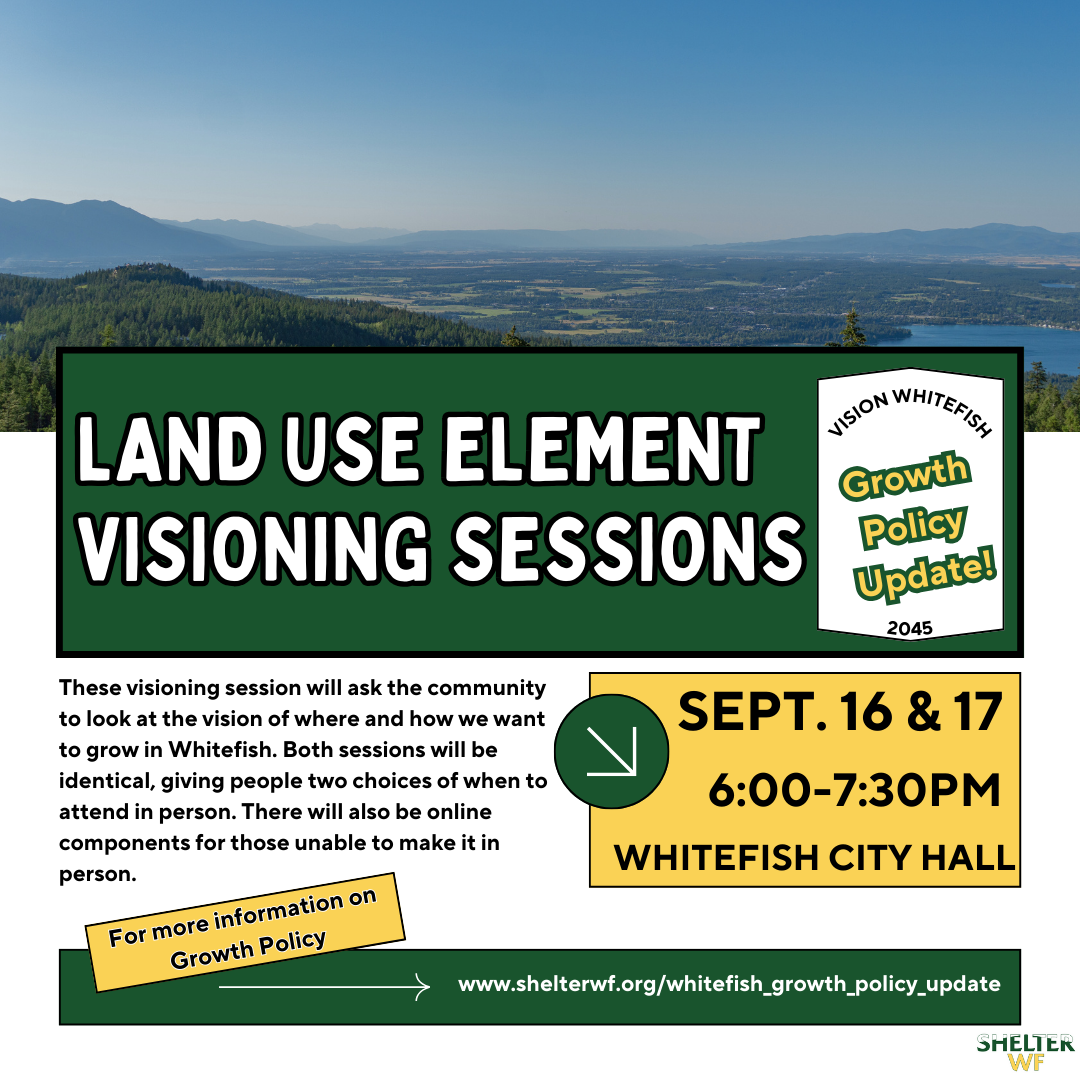
The sessions will take place at Whitefish City Hall on the following dates:
- September 16, 2025 from 6 - 7:30pm
- September 17, 2025 from 6 - 7:30pm
There will also be an option to participate online if you are unable to make these sessions, however, if you are available to make it in person, we ask that you come in person. The CDB has a history of negating the voices and viewpoints of those that they disagree with during this process, often claiming that "no one" expressed preferences for certain changes at visioning sessions hosted in early 2024. There are more eyes on the process now, and we do not feel that they will be able to do this following these September visioning sessions but we remain concerned that they will do this with any input provided online rather than in person based on past behavior. PLEASE SHOW UP IN PERSON IF YOU CAN!
UPDATE 8/27/2025
On August 27, 2025, the Whitefish Community Development Board (CDB) once again demonstrated its hostility toward building homes for locals and workers by revisiting the Hazards section of the Growth Policy. Months after initially adopting the section on June 18, 2025, the board dragged it back for additional discussion and changes, continuing its pattern of stacking the Growth Policy against certain parts of the community - notably, those who struggle to afford to live here or who have already been priced out.
The CDB has consistently added language to the draft Growth Policy that aims to reduce the city's ability to allow for more, and more affordable, homes. Last week's meeting was no exception. This ongoing process of adopting chapters only to bring them back later effectively limits public participation, as residents may have assumed these issues were already settled. This pattern not only silences the public but also increases the city's legal risk by elevating the voices of a few special interests and political insiders above the community.
The most egregious change made to the Hazards section on August 27 was a recommendation for a development moratorium if a second evacuation route from the Big Mountain area isn't established in a short period of time. This move is likely illegal, and the board couldn't even articulate what it meant. What areas of Whitefish are they talking about? We don't know, but given that groups like FFRG claim the entire city is within the Wildland-Urban Interface (WUI), we have serious concerns that this is a thinly veiled attempt to prevent any new homes from being built in Whitefish. At the very least, based on Whitefish's history, this will be used to block the development of climate-friendly and affordable housing options while continuing to promote urban sprawl and further encroachment on the WUI.
The updated draft of the Hazards section is not yet available, but it should be soon at Engage Whitefish.
UPDATE 8/22/2025
Whitefish CDB Fails to Address Housing Crisis, Prioritizes Visitor Economy
The Whitefish Community Development Board (CDB) met on Wednesday, August 20, 2025, for what many hoped would be a genuine reconsideration of the Economic Development chapter of the Growth Policy. Instead, the meeting served as a formality, with a majority of the board (Mallory Phillips and Toby Scott generally representing the minority again) upholding edits that directly benefit the visitor economy at the expense of local residents. Despite public calls to address the needs of our community, the board's actions made it clear they intend to keep Whitefish an exclusive playground for wealthy second-homeowners, rather than a place to call home for all.
In a series of moves that prioritize the tourist economy over the needs of permanent residents, the board voted to keep out or weaken key provisions aimed at promoting local businesses, essential services, and affordable housing.
The board voted to remove or weaken the following items:
-
- A provision stating the city would "endeavor to provide a full range of goods, services, and jobs to serve our local population" was left out. (page 2)
- The board removed the objective to "review zoning to diversify business locations and to encourage necessary local serving goods and services near local population centers". (page 15)
- A change was made to "prohibit" big box retail, removing the previous language that sought to "restrict and regulate" it and "explore adding an economic impact analysis requirement for proposals". The board also changed a provision from regulating formula hotels and services to outright "prohibit" them. (page 16)
- Language that would have supported "creative lower-cost enterprises that cater to locals such as food trucks or temporary 'pop up shops'" was left out. (page 16)
- An item to "consider future zoning amendments to allow small-scale neighborhood serving light commercial or mixed-use in appropriate areas" was not included. (page 16)
- A provision to "study the feasibility of a demand based paid downtown parking program" was removed. This program could have helped create revenue for downtown beautification, new public parking lots, or public transit to benefit residents and visitors. (page 17)
- The phrase "and farm stops" was left out of a sentence that would have supported farm-based produce stands and farmers markets. (page 17)
Why are these omissions bad?
These omissions are bad because they directly undermine the goals of creating an inclusive, affordable, and sustainable community. By rejecting measures that would support local-serving businesses and diversify the economy, the board has instead reinforced a system where our town is designed to serve a high-income, transient population.
The board voted to reinstate or modify the following items, with an overall positive effect on the chapter:
-
- Added back context that "local families [had] to move away" following the 2008 recession in the opening paragraph of the document. (page 2)
- Removed language suggesting that locals "choose" to commute outside of Whitefish for work. (page 3)
- Directed staff to add references for figures provided by Explore Whitefish on pages 4-8. Edits to these pages removed staff-referenced data that existed previously. It was unclear at the time of the meeting if references are available for these numbers.
- Added back context that "76% of workers employed in Whitefish do not live in Whitefish." (page 6)
- Updated a misleading figure claiming that the average Whitefish worker pays $800 for rent in town. (page 7)
- Added back a sentence describing some of the negative impacts of tourism on page 7.
- Added back two provisions that aim to increase the diversity of business types in the downtown core. (pages 14 and 17).
Though these generally represent small victories, the board added back some key context and restored some provisions that acknowledge the negative impacts of tourism and the struggles of local workers and families.
When updated by city staff, the adopted document will be available at https://engagewhitefish.com/vision-whitefish-2045.
The next Growth Policy meeting will take place next week as the board again reviews the Hazards section, which is previously adopted. Following that, the board will meet on September 17, and this will likely focus on the beginnings of consultant work for the Land Use chapter of the Growth Policy. Staff is also working on a draft of the Transportation chapter, which will be brought forward in September or October.
UPDATE 8/8/2025
Shelter WF has obtained funding to devote staff time to this project. Thanks to this funding, we expect to be much more active in the Growth Policy update going forward, and expect to be very active as the city is contemplating residential zoning changes leading into its May 2026 implementation deadline. Regular updates will be provided on this page.
The Whitefish Community Development Board (Planning Board) is responsible for working on the Growth Policy draft before this document is sent to the Whitefish City Council for adoption. To date, the Community Development Board (CDB) has reviewed and approved the following elements and chapters of the Growth Policy:
- Vision
- Planning Framework
- History
- Demographics
- Public Facilities
- Environment, Natural Resources and Hazards* - Hazards section to again be discussed at August 20, 2025 meeting.
- Economic Development* - adopted edits to be reviewed line-by-line at August 20, 2025 meeting.
Remaining elements/chapters include:
- Transportation - September 2025
- Housing and Land Use - October/November 2025
- Review of full Growth Policy draft as one document - December 2025/January 2026
Meeting Date: August 20, 2025 (Whitefish Community Development Board) at 6 p.m. - RSVP here!
We have been hard at work reviewing the adopted changes to the Whitefish Growth Policy's Economic Development chapter. We've identified several concerning edits that we believe the Community Development Board should reconsider. Read our full letter here.
Here’s a quick summary of our key points:
-
Serving Locals: We urge the board to restore the original vision of providing a full range of goods, services, and jobs to serve our local population. Removing this goal forces residents to travel for basic needs, essentially acting as a tax on our community.
-
Challenging Misinformation: The revised language frames commuting as a "choice" for residents, which ignores the reality that many non-hospitality workers must seek higher-paying jobs in places like Kalispell. We're asking the board to revert to the factual, staff-provided draft.
-
Economic Diversification: To build a more stable, year-round economy, we want the plan to actively encourage the development of businesses outside of tourism and hospitality. This would help sustain local businesses and create more stable jobs during the shoulder seasons.
-
Accurate Data: We believe the policy should accurately reflect our community's challenges. We're pushing to restore key facts, such as the statistic that 76% of Whitefish workers don't live in Whitefish. We also want to remove misleading statements about average rent prices that don't reflect the true cost of living for most residents.
-
Flexibility and Public Input: We are concerned that some of the proposed edits, such as attempts to prohibit certain business types or remove objectives for future zoning reviews, are shortsighted and influenced solely by downtown business special interests. We believe the Growth Policy should remain a guiding document, not a tool for attempting to write restrictive zoning policy or silencing the voices of the residents who participated in the original visioning sessions.
Meeting Date: August 20, 2025 (Whitefish Community Development Board) at 6 p.m. - RSVP here!
ORAL TESTIMONY
-
Testimony will take place at Whitefish City Hall (upstairs in City Council Chambers) at 6:00 pm on Wednesday, August 20, 2025.
-
This item will have its own public hearing. When the public hearing is called, you simply need to step to the podium to speak. It is not necessary to sign in to speak. You can provide around 3 minutes of oral testimony, and the board typically does not answer questions during this time.
-
Not sure what to say? See below!
WRITTEN TESTIMONY
-
Written testimony can be as long or short as you like. Submit by sending an email to Alan Tiefenbach at [email protected].
-
Written testimony can be submitted at any time before the Community Development Board meeting, but the sooner you submit it, the better.
-
Not sure what to say? See below! Or you can simply say, “I am concerned with the previously adopted edits to the Economic Development Chapter of the Growth Policy. These edits remove much of the community input that was gathered over multiple visioning sessions last year. I urge the Community Development Board to reconsider many of these adopted edits and to revert back to the original draft created by city planning staff in most, if not all, cases.”
ORAL/WRITTEN TESTIMONY TEMPLATE
You can use the following testimony as inspiration, to build upon, or as a ready-to-submit letter (after you fill in the blanks). ***This letter is not ready to send - it needs to be edited***
Dear Members of the Whitefish Community Development Board,
I am writing to you today as a concerned resident about the previously adopted edits to the Economic Development chapter of our Growth Policy. While I appreciate the work you are doing, I've reviewed the changes and feel that some of them could negatively impact the future of our community. I am particularly concerned that these changes don't fully serve the needs of Whitefish residents and seem to favor a narrow set of interests.
I believe we should hold onto the original vision of providing a full range of goods, services, and jobs right here in Whitefish. Removing this goal is a step backward and forces many of us to drive to Kalispell or Columbia Falls for basic necessities. This not only adds to traffic and pollution but also puts an extra financial burden on every household.
I also strongly disagree with the language that frames a resident's choice to commute as simply that—a "choice." The reality is, many people are forced to seek higher-paying jobs outside of Whitefish because they simply cannot afford to live here. It’s important that our Growth Policy be based on the facts of our housing crisis, not a misunderstanding of it.
To build a more resilient community, I think it's vital that we add language to the policy about diversifying our economy. A strong, year-round economy that isn't solely dependent on tourism would help our local businesses thrive and provide stable jobs, especially during the shoulder seasons.
Furthermore, I was surprised to see key factual data removed from the document, such as the statistic that 76% of workers in Whitefish do not live here. This is crucial context for our housing challenges. The addition of misleading rental figures also concerns me, as it appears to downplay the severity of our affordability problem. The document should be grounded in accurate data and honest assessments.
Finally, I worry that some of the new edits are trying to shut the door on future opportunities by attempting to write restrictive zoning policy into a guiding document. Things like "pop-up shops," neighborhood bodegas, and food trucks are part of a vibrant, modern economy. We should give future city councils the flexibility to adapt and innovate, rather than locking in the preferences of a few.
[This is where your unique, personal story is most powerful. Please share your own experience here, in your own words. For example, you could talk about:
-
The struggle to find a stable, year-round job that pays enough to live in town.
-
The stress of commuting to Kalispell every day.
-
How you or your family were priced out of the housing market.
-
The challenges of being a local business owner during the off-season.
Make it personal. Make it yours. This is what will make your letter stand out and have the most impact.]
Thank you for your time and for considering my concerns. I urge you to take a holistic, long-term view of our community and restore the language (drafted by city planning staff) that prioritizes residents and a more flexible, prosperous future for all of Whitefish.
Sincerely,
[Your Printed Name]
[Your Address - Optional]
UPDATE 1/22/2024
Visioning sessions have been scheduled! These sessions are where you get to share your vision for the future that you want to see in Whitefish and are a crucial step in the growth policy process - this is the beginning of the work that will shape our town over the next 20 years. The city will hold TWO IDENTICAL SESSIONS on February 21 and February 22, 2024 (Wednesday and Thursday), beginning at 5:30 p.m.
The first surveys have been completed - here are the results:

Top 5 things that survey respondents value about Whitefish:
- The local outdoor recreation activities (skiing, biking, hiking, water activities)
- The local small-town community and the diversity of people and income levels
- The scenic resources (mountains, water, open space, wildlife)
- Public trails, parks, and open space
- Walkability (sidewalks, pathways, pedestrian-level interest)

Top 5 biggest threats/challenges that survey respondents identified for Whitefish:
- Cost and availability of housing
- Impacts of short-term rentals on housing needs and residential neighborhoods
- Traffic congestion
- Shortage of local workers
- Scale and compatibility of new development with existing development
Growth Policy Elements Ranked in Order of Importance to Survey Respondents

About Shelter WF
Shelter WF is a 501(c)(4) organization dedicated to increasing housing abundance and affordability in Whitefish and throughout Montana.
Recent Campaigns
- Whitefish Growth Policy Update (Vision Whitefish 2045)
- Alpenglow Phase 2 - Whitefish Affordable Apartment Homes
- Whitefish Corridor Community - Passed on 6/19/2023
- Whitefish Community Housing Committee - Established on 1/3/2023
- Depot Park Townhomes - Passed on 12/19/2022
- Accessory Dwelling Unit (ADU) Code Updates - Passed on 5/16/2022
© 2025 Shelter WF. All rights reserved.
Do you like this page?